Computers Were Once a Fear. Now It’s AI. Will History Repeat Itself?
History suggests technology often changes work more than it eliminates it
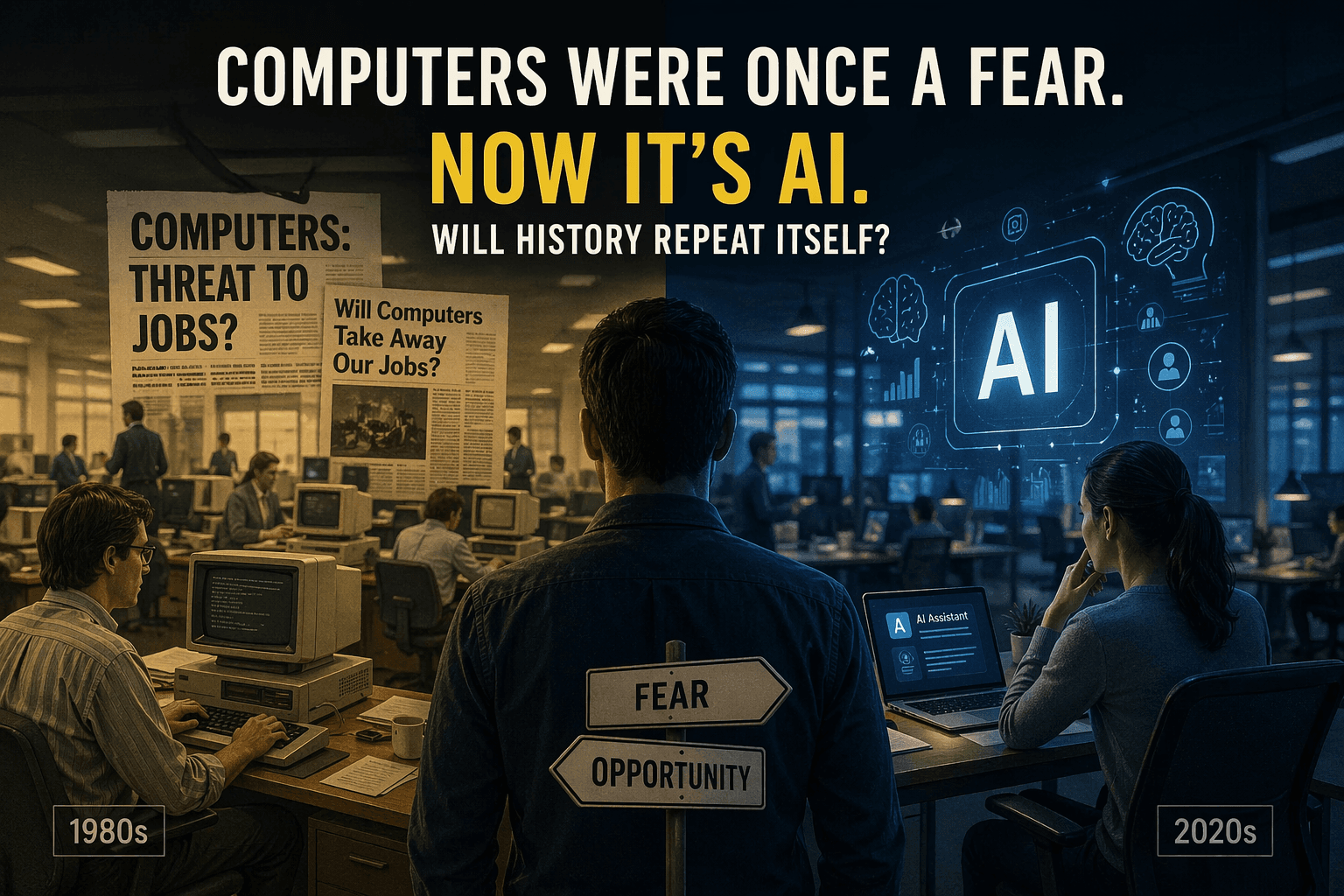
Computers Were Once a Fear. Now It’s AI. Will History Repeat Itself?
History suggests technology often changes work more than it eliminates it.
Deepa R
7 min read · Apr 24, 2026
Every major technological shift seems to begin with the same question:
Will this replace people?
Today, that fear is focused on AI.
Employees worry their roles may disappear.
Students wonder whether future careers will still exist.
Professionals across industries are questioning how valuable their skills will remain.
The concern is understandable.
But this is not the first time society has faced uncertainty like this.
When computers began entering workplaces and homes at scale, many believed machines would eliminate jobs. Instead, something more complex happened.
Work changed.
That historical pattern may offer an important lesson for the AI era.
When Computers Became Mainstream
Before computers were common, many everyday tasks were manual:
Payroll was processed by hand
Records were stored in filing cabinets
Letters were typed and mailed
Calculations took significant time
Information retrieval was slow
As computers spread through offices in the 1980s and 1990s, many feared automation would remove millions of workers permanently.
Some tasks did shrink.
But computers also increased productivity, created new industries, and changed how existing jobs were done.
Think about careers that expanded because of the computer age:
IT support
Software engineering
Digital marketing
Web development
Data analysis
Cybersecurity
Product management
UX/UI design
E-commerce operations
Many modern careers barely existed before widespread computing.
History Has Seen This Before
This pattern existed even before computers.
During the Industrial Revolution, machines transformed agriculture and manufacturing. Many feared permanent unemployment.
Instead, economies shifted. Factory work grew. Transportation expanded. Services increased. New professions emerged.
Later, ATMs were expected to eliminate bank teller jobs. Instead, teller roles changed toward customer service and relationship-focused work as branch numbers expanded.
Technology often removes specific tasks first.
Then it reshapes roles.
The Internet Repeated the Pattern
Then came the internet.
Again, people feared disruption.
Instead, the internet created new forms of work:
Online businesses
Remote collaboration
Digital content creation
Global freelancing
Social media management
Online education
App-based services
Technology replaced some methods.
It also created entirely new markets.
AI Is Now Doing Something Similar
AI is different in speed and capability, but the pattern feels familiar.
AI can already help with:
Drafting documents
Summarizing research
Writing code snippets
Analyzing large datasets
Automating repetitive admin work
Generating ideas quickly
Translating and reformatting content
This can feel threatening because AI touches knowledge work, not only manual tasks.
But in many cases, AI is replacing tasks, not entire professions.
That distinction matters.
A job is usually a bundle of responsibilities:
Communication
Decision-making
Judgment
Collaboration
Accountability
Context awareness
Problem solving
Even when AI handles part of the workload, humans often remain responsible for outcomes.
Economists Often Make the Same Point
Across history, productivity gains from technology have often lowered costs, increased output, and created demand for new goods and services.
When new demand appears, new jobs often follow.
That does not mean every transition is painless.
Some workers are displaced. Some skills lose value. Some industries shrink.
But long term, economies tend to reorganize rather than simply disappear.
The challenge is usually transition — not extinction.
The Real Shift: From Doing Everything to Doing Higher-Value Work
Spreadsheets did not eliminate finance professionals. They changed finance work.
Email did not eliminate communication. It accelerated it.
Search engines did not eliminate knowledge workers. They increased access to information.
AI may do something similar.
Instead of spending hours on repetitive first drafts, sorting data, or manual admin tasks, people may spend more time on:
Strategy
Relationships
Creative direction
Critical thinking
Complex decisions
Customer understanding
Leadership
That is often how technology reshapes careers.
The People Who Benefit Most Usually Adapt Early
When computers became standard, digital literacy became essential.
Those who learned early gained an advantage.
The same may happen with AI.
The strongest professionals may not be those who avoid AI, but those who learn:
How to use it responsibly
Where it saves time
Where human review is required
How to improve quality with it
How to combine speed with judgment
Over time, AI fluency may become as normal as knowing email, spreadsheets, or search tools.
What AI Still Struggles With
AI is powerful, but it still has limitations.
Humans remain critical where work depends on:
Trust
Ethics
Leadership
Empathy
Negotiation
Cultural nuance
Accountability
Long-term judgment under uncertainty
These are not side skills.
In many careers, they are often the highest-value skills.
The Bigger Risk May Be Standing Still
Many people frame the future as:
Humans vs AI
Jobs vs automation
Winners vs losers
But the more realistic divide may be:
People who adapt
vsPeople who refuse to evolve
This happened with computers.
It likely happens with every major shift.
A Better Question to Ask
Instead of asking:
Will AI replace me?
Ask:
What part of my work can AI improve?
Which skills become more valuable now?
How can I use AI to create better results?
Where does human judgment matter most in my role?
What should I learn next?
That mindset turns fear into leverage.
Final Thought
When computers arrived, many believed jobs would disappear.
Instead, jobs changed, industries expanded, and new careers emerged.
AI may follow a similar path.
Some tasks will fade.
Some roles will evolve.
New opportunities will appear.
Expectations will rise.
The future may not belong to those who fear technology.
It may belong to those who learn to grow with it.
Computers changed how we worked.
AI may change how we create value.

Deepa Rote
Product Designer | UX Strategy Enterprise | AI Experiences
If you like what you see or have any questions, feel free to send me an email anytime.
Share this article
Recent articels
I write about the future of design and the life of a product designer
How smart designers use AI without losing their edge
A lot of designers won’t say it out loud, but many are worried about AI.
Apr 21, 2026
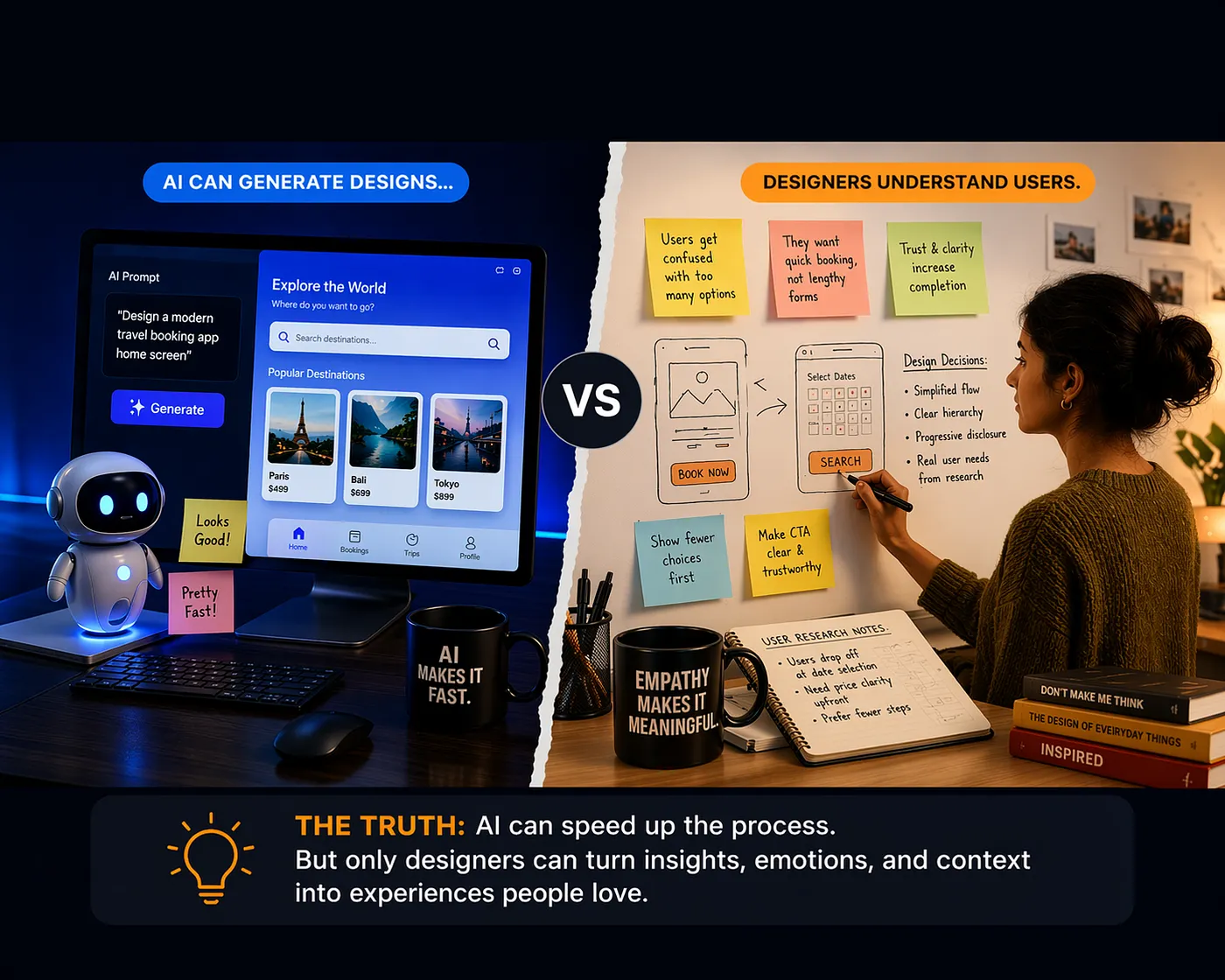
Companies Think AI Will Replace Designers. They’re Missing One Big Truth.
Why AI can generate screens, but still can’t replace UI/UX design thinking, human expertise, and user understanding.
Apr 17, 2026